Some expenses are surprises. Others only feel like surprises because they arrive a few times a year instead of every month. A car registration renewal, a home repair, holiday travel, annual insurance premium, or replacement appliance may not land on your usual payday schedule, but none of them should automatically become credit-card debt.
A sinking fund is a simple way to make room for those predictable-but-irregular costs. You name the expense, estimate what it may cost, choose a deadline, and set aside a small amount each month or paycheck. When the bill arrives, the money already has a job.
This guide shows how to use sinking funds without creating a complicated maze of bank accounts. You will learn which expenses deserve their own fund, how to calculate a contribution, where to keep the money, and how to adjust when life changes. It is general financial education, not personalized financial or tax advice.
What is a sinking fund?
A sinking fund is money saved gradually for a known future expense. The expense may have an exact due date, such as an annual insurance bill, or a likely time window, such as tires that will need replacing within the next year. The key difference is that the expense is expected.
Think of it as turning a large, lumpy bill into a smaller routine line item. Instead of saying, “I need $900 next summer,” you say, “I will set aside $75 a month for 12 months.” The final bill does not disappear, but it stops competing with rent, groceries, and your other current priorities all at once.
A good budget already gives every current dollar a purpose. Sinking funds extend that idea into the future. They make the annual and occasional parts of real life visible before they create stress.
Sinking fund vs. emergency fund: use the right bucket
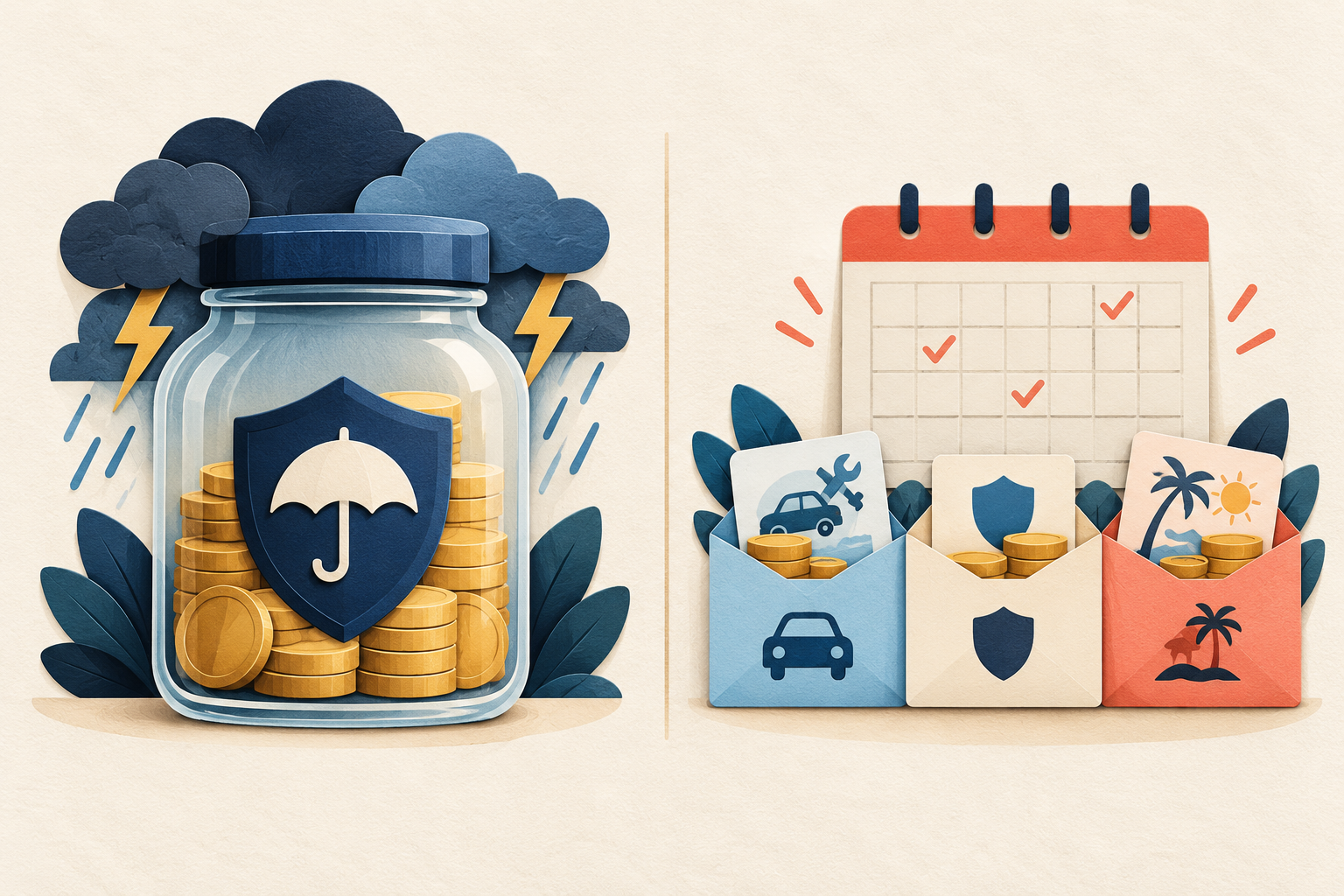
An emergency fund is for events you did not reasonably plan for: a sudden job interruption, an urgent medical bill, a major unexpected repair, or an unplanned trip to help family. A sinking fund is for a purpose you can see coming, even if the final amount is imperfect.
This distinction matters. If every planned cost comes out of your emergency savings, you may feel as if you can never make progress. In reality, the reserve is being asked to do two jobs. Keeping the buckets separate lets your emergency fund remain a true cushion while planned costs have their own runway.
If you are still building a cash reserve, you do not need to wait until it is perfect to start planning ahead. Our guide to building an emergency fund on a tight budget can help you establish a first layer of protection while you start with one small sinking fund.
Which expenses should get a sinking fund?
Start with costs that meet three tests: they are likely to happen, they are meaningful enough to disrupt a month, and you can estimate a rough amount or time frame. Do not open twelve funds on day one. Begin with the expenses that have hurt your budget before or will be due soonest.
| Expense type | Why it fits | Useful planning cue |
|---|---|---|
| Insurance premiums and deductibles | Often billed annually or semiannually | Check the renewal notice and payment schedule |
| Car maintenance and registration | Maintenance is recurring even when timing varies | Review last year’s repairs and upcoming service |
| Home maintenance | Small repairs and seasonal upkeep are normal ownership costs | List likely projects, not only disasters |
| Holidays, gifts, and travel | Dates are predictable; spending can be capped | Set a total before booking or shopping |
| Medical and pet care | Routine visits and deductibles can be anticipated | Use your plan details and recent bills |
| Professional renewals or school costs | Fees often have a known due date | Put the date on your calendar now |
A down payment, a planned move, or a future car purchase can also be a sinking fund, but it may need a separate plan because the target is much larger. For a house purchase, review the broader cash requirements in our guide to the hidden costs of buying a house; the purchase price is only one part of the target.
How to calculate your monthly sinking-fund contribution
The core calculation is deliberately plain:
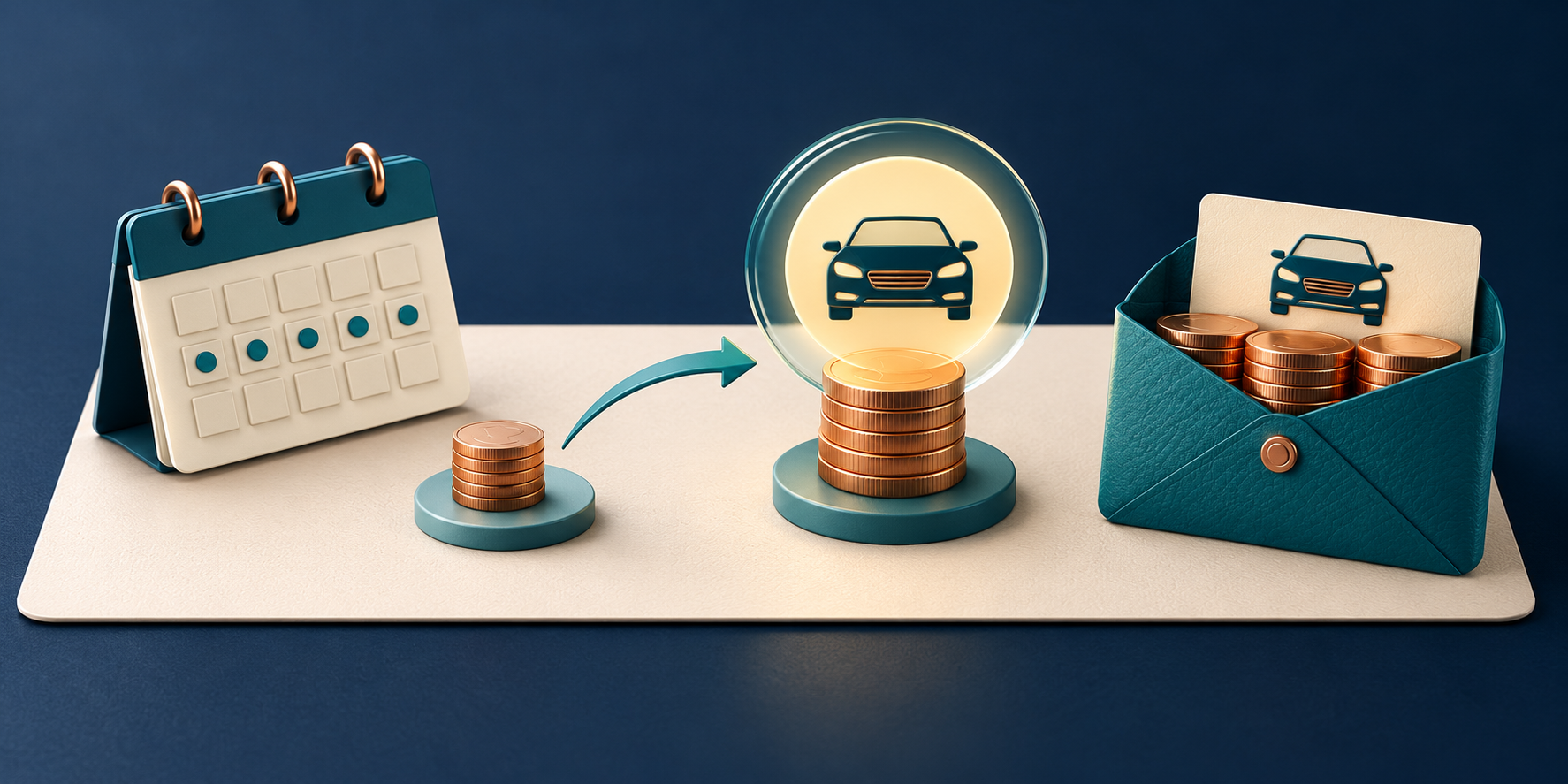
(Estimated cost − money already saved) ÷ months until you need it = monthly contribution.
For example, suppose your car insurance premium is expected to be $1,200 in 10 months and you already have $200 set aside. You need another $1,000. Dividing that by 10 gives a monthly target of $100. If you are paid twice a month, you could move $50 from each paycheck instead.
Use estimates honestly. A sinking fund does not require perfect forecasting; it requires a useful starting point. Look at last year’s bill, recent receipts, a renewal quote, or a conservative range. If an expense may be $600 to $900, planning toward the higher end can give you room. If the final number is lower, the extra stays available for the next round.
For variable expenses such as car repairs, choose a yearly target rather than pretending you can predict one repair. Review your maintenance history, age of the car, and known service needs. You can revise the target as you learn more.
Build your first sinking-fund list
Set aside 20 minutes with a calendar, bank statements, and last year’s major receipts. Scan the next 12 months first, then add a few recurring categories. A short list is more likely to be funded than an ambitious list you abandon.
- Write every nonmonthly expense you remember. Include bills, celebrations, appointments, maintenance, and memberships.
- Mark its due month or expected window. Use the calendar, not memory.
- Estimate a cost. Use a receipt, quote, or deliberately cautious estimate.
- Subtract existing savings. Do not count money reserved for another goal.
- Divide by the remaining months or paychecks. This reveals the real monthly cost.
- Prioritize the total. If all the contributions do not fit, reduce targets, extend nonessential deadlines, or start with the closest high-impact funds.
This exercise can be eye-opening. It may show that a budget has less free cash than it appeared to. That is not bad news; it is useful information. A budget is a written plan for how you will spend and save, and it can include savings as a regular expense. For ideas on making the rest of your plan work, see our practical ways to save money.
Where should you keep sinking-fund money?
For goals you expect to use within a year or two, prioritize safety and access over chasing a higher return. A savings account at an FDIC-insured bank can be a straightforward home for money you may need on schedule. Confirm the institution and account are eligible for deposit insurance, and understand any transfer timing or account rules.
You have several workable setups:
- One savings account with a tracker. Keep a simple spreadsheet, note, or budgeting-app category showing each fund’s balance. This is often enough.
- Separate savings accounts or bank “buckets.” Useful if visual separation helps you avoid spending a future bill.
- Cash envelopes for small, near-term categories. Helpful for holiday gifts or local spending, but less suitable for large balances or online bills.
The best system is the one you can maintain. More accounts are not automatically more organized. If transfers, minimum balances, or fees create friction, use one account and clear labels instead.
Automate it so the decision happens once
Automatic transfers turn a good intention into a repeatable routine. Schedule the transfer for shortly after payday, when your balance is most likely to support it. Label it with the fund name if your bank allows it. The FDIC also notes that regular automated deposits can help build savings for future goals.
Automation is not a promise that every month will be easy. It is a default. If income changes or an urgent bill arrives, pause or reduce a transfer intentionally, then revisit it. That is different from forgetting the fund exists until the due date.
When cash flow is tight, start with a smaller recurring amount. Saving $15 per paycheck for a known bill is more useful than waiting for the mythical month when you can save everything at once. A no-spend reset can also create a temporary boost; our no-buy challenge guide has ideas for setting boundaries without treating every purchase as a failure.
What to do when your total is more than you can save
Adding up all future needs can produce an uncomfortable number. Do not solve it by quietly ignoring the list. Use the gap to choose among real tradeoffs.
- Fund legally required, essential, or nearest-due expenses first.
- Reduce flexible categories, such as gifts, travel, or discretionary upgrades.
- Ask whether an annual bill can be paid monthly and compare any fees or interest.
- Sell or postpone an optional purchase rather than borrowing for a predictable one.
- Redirect a temporary windfall, refund, overtime payment, or bonus with a specific purpose.
- Adjust the next year’s target after this year’s bill is paid.
Do not raid retirement accounts or take high-cost debt lightly to make a planned expense look funded. For large obligations, a broader plan may be needed. The goal is to improve next month and next year, not manufacture perfection today.
Common sinking-fund mistakes
Treating every expense as an emergency
A planned premium, worn tires, and December gifts may be inconvenient, but they are not all emergencies. Give recurring costs a name before they become a crisis.
Forgetting irregular income
If your pay varies, base your core plan on a conservative income level. During stronger months, add extra to the most urgent fund. This makes the system steadier than committing your best month’s income every month.
Using one vague “miscellaneous” fund
One flexible buffer can be useful, but vague money gets spent easily. At minimum, separate true emergencies from known obligations.
Never reviewing targets
Insurance prices, travel plans, and vehicle needs change. A fund based on an old estimate can create false confidence. Review it on a schedule.
Do a simple annual reset
Choose one review date each year—perhaps the first weekend of January, your birthday month, or the month before annual enrollment. Pull up your list and ask what is due, what changed, and which balances have a surplus or shortfall.

Use the review to close completed funds, roll excess money into the next occurrence of the same expense, and add new responsibilities. If you moved, changed cars, adopted a pet, or began planning a major purchase, your old list is no longer the whole picture. Pair the review with your broader money check-in; our smart money moves guide offers a useful wider checklist.
A realistic starter example
Imagine that Maya wants her budget to absorb three predictable costs over the next year: an $840 insurance premium due in eight months, $360 for holidays in six months, and $600 for routine car care over the full year. She has $120 already saved for insurance and nothing in the other categories. Her starting monthly targets are $90 for insurance (($840 − $120) ÷ 8), $60 for holidays ($360 ÷ 6), and $50 for car care ($600 ÷ 12). Together, that is $200 a month.
If $200 does not fit, Maya does not have to give up. She can protect the insurance deadline first, lower the holiday budget, set aside $30 monthly for car care while she rebuilds cash flow, and direct part of a future windfall to the gap. Her plan is honest about what the calendar requires, but it also leaves her choices. After the insurance bill is paid, that $90 can roll into the next renewal or another priority.
This is the hidden advantage of sinking funds: they make tradeoffs early, when you still have options. A vague future bill becomes a visible monthly decision instead of a last-minute scramble.
Frequently asked questions
How many sinking funds should I have?
Start with two or three. The right number is the fewest that make your upcoming expenses clear and manageable. Add categories only when they solve a real planning problem.
Should a sinking fund be in a separate account?
Not necessarily. A dedicated savings account or bucket can help, but a single account with accurate labels works too. Prioritize low friction, safety, and a way to see each purpose clearly.
Can I use a sinking fund for a vacation?
Yes. A vacation is a classic planned expense. Give it a total budget and deadline, then save gradually. Keeping it separate from emergency savings helps prevent a trip from becoming debt later.
What if I need the money early?
Use it for the purpose it was assigned to if that need arrives earlier than expected, then revise the plan. If you use it for something unrelated, acknowledge the tradeoff and restart the contribution rather than pretending the fund is still complete.
The bottom line
Sinking funds are not about having a separate account for every possibility. They are about recognizing that many “unexpected” bills are actually future expenses waiting for a plan. Start with one important category, calculate a realistic contribution, automate it, and review it regularly. Over time, those small transfers can make your budget feel less fragile and your emergency fund more available for actual emergencies.