
How to Create a Retirement Paycheck Plan
Retirement is not only a question of whether you have saved enough. It is also a question of how money will arrive, where it will come from, and what you will do when a month costs more than you expected. A retirement paycheck plan turns a pile of accounts into a practical system for paying yourself.
The goal is not to predict markets perfectly or to find one magical withdrawal percentage. It is to create a repeatable routine: know your baseline spending, line up dependable income, choose how withdrawals will fill the gap, set aside near-term cash, and review the plan before small surprises become big ones. That structure can make the first years of retirement feel far less improvisational.
This guide is educational, not individualized investment or tax advice. Retirement-account rules, pensions, health coverage, and taxes vary, so consider a fiduciary financial professional or tax professional before acting on a withdrawal strategy.
What is a retirement paycheck plan?
A retirement paycheck plan is a written process for moving money from your income sources and savings into your checking account on a schedule. It answers five everyday questions:
- What does our household need each month, including irregular expenses?
- Which income sources cover that amount automatically?
- How much must investments or cash reserves provide this year?
- Which account will a withdrawal come from, and when?
- When will we review taxes, spending, and investment risk?
That is different from simply owning a 401(k) or IRA. Accounts are containers; a paycheck plan is the operating system. It also differs from a strict promise to withdraw the same percentage every year. A useful plan gives you guardrails while leaving room for a roof repair, a down market, a new health-care need, or a change in family priorities.
Start with the spending your plan must support
Begin with actual spending, not a broad rule of thumb. Pull 12 months of bank and card transactions, then sort them into categories. Your core spending is the amount required to keep ordinary life running: housing, groceries, utilities, insurance, transportation, debt payments, taxes, and basic health care. Your flexible spending includes travel, gifts, hobbies, dining out, and optional projects.
Then add the costs that do not appear every month. Property taxes, homeowners insurance, car registration, holiday gifts, dental work, and home repairs can make an otherwise sound monthly plan look wrong. A sinking fund for irregular expenses lets you divide those annual or occasional costs by 12 and save or reserve for them gradually.
It helps to use three spending lines rather than one:
| Line | What it includes | Why it matters |
|---|---|---|
| Floor | Needs and essential bills | The amount your reliable income and reserves should protect first. |
| Comfort | Normal lifestyle, routine fun, gifts, and modest travel | The realistic target for an ordinary year. |
| Stretch | Big trips, renovations, family help, or special purchases | The part you can postpone if markets or health costs disappoint. |
If you are still working, use your current budget as a starting point, then change what will truly change: commuting may fall, while insurance, travel, and out-of-pocket care may rise. The Consumer Financial Protection Bureau specifically encourages future retirees to make a retirement budget and notes that some costs, including health care, may increase with age. Do not assume every expense drops the day paychecks stop.
Map every income source by amount, timing, and reliability
Next, make a one-page income map. List the gross amount, expected net amount after withholding, start date, payment frequency, inflation adjustment if any, and whether the payment continues for a spouse. Typical entries include Social Security, pensions, part-time work, rental income, annuity payments, dividends and interest, and portfolio withdrawals.
Separate income into two buckets:
- Reliable income: payments you expect on a known schedule, such as Social Security or a pension.
- Variable income: portfolio income, contract work, bonuses, rent after expenses, or anything whose amount and timing can change.
Reliable income does not have to cover every dollar of your comfort budget. But knowing how much of your floor it covers tells you how dependent the household is on withdrawals during a difficult market. If you are deciding when to claim Social Security, remember that claiming age and retirement date are separate decisions. The CFPB explains that retirement savings can sometimes bridge the gap to a later claiming age, but that tradeoff should be tested against your savings, health, work options, and survivor needs.
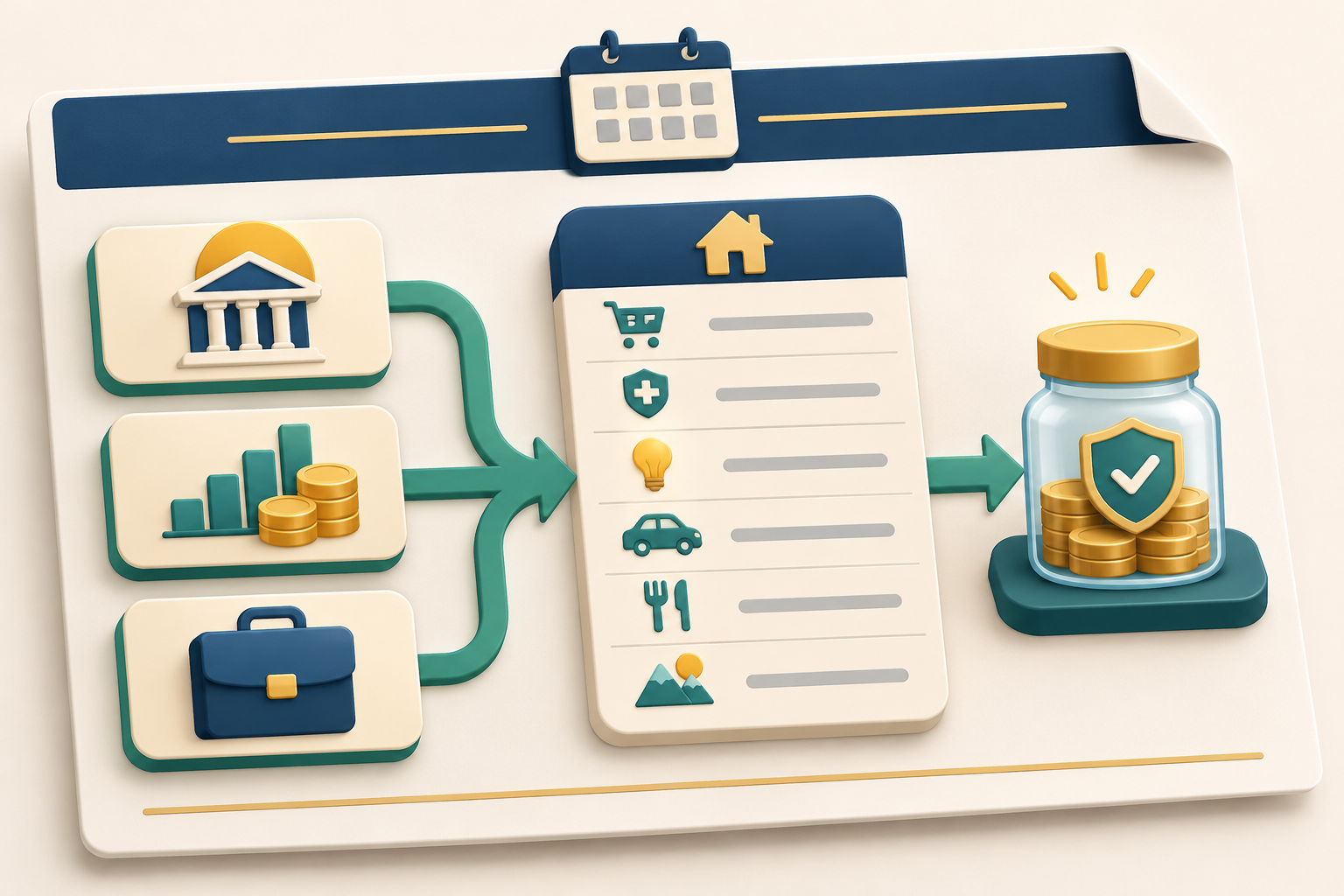
Calculate the annual income gap
The basic math is simple:
Annual spending target − dependable after-tax income = amount your savings must provide.
For example, imagine Maya and Devon need $72,000 for their comfort budget this year. Their Social Security and small pension are expected to deliver $48,000 after withholding. Their first-pass portfolio need is $24,000 for the year, or $2,000 a month. If they also want $6,000 for a major trip, they can label that as stretch spending instead of quietly treating it as a permanent baseline.
That distinction is powerful. It shows which costs are negotiable if investment values fall and which must be funded regardless. It also gives you a clear number to revisit after a move, an insurance change, or a significant market year.
Build a cash-flow schedule, not just an annual total
An annual retirement budget can be accurate and still leave your checking account awkwardly empty in a high-expense month. Translate the annual gap into a calendar. Many retirees use a separate checking account for routine bills, a savings account for planned irregular costs, and investment or retirement accounts for replenishing those accounts.
One simple approach is a “paycheck” transfer: direct reliable income to checking, then transfer a planned amount from savings or an investment account on the first or fifteenth of each month. Some people prefer quarterly transfers to reduce transactions. The right cadence is the one that makes bills easy to pay without tempting you to treat the whole year’s cash as available for this month.
Keep a near-term reserve for spending you do not want to fund by selling long-term investments at an inconvenient moment. The reserve is not a prediction that markets will fall; it is a practical buffer for cash-flow timing. Its appropriate size depends on your income stability, flexibility, insurance, debt, and comfort with volatility. Pair it with the same kind of planned reserves you use in a retirement budget so property taxes and annual premiums do not masquerade as emergencies.
Choose a withdrawal order deliberately
A withdrawal order is the sequence you use to meet the income gap from taxable accounts, traditional tax-deferred accounts, Roth accounts, cash, or other sources. There is no universal order. The best choice can change with your marginal tax rate, future required minimum distributions (RMDs), capital gains, charitable goals, Medicare-related premiums, estate plans, and state taxes.
Still, a written order prevents accidental decisions. Your plan might say: use checking and designated cash first for monthly bills; draw planned distributions from a traditional IRA each quarter; use a taxable account for a defined one-time purchase; preserve Roth assets for later years or large contingencies. Or it may use a blended approach designed around a tax target.
Be precise about taxes. Traditional IRA and many workplace-plan distributions are generally taxable, while qualified Roth distributions are generally tax-free. RMDs cannot be rolled over to another tax-deferred account, and the account owner remains responsible for taking the correct RMD even when a custodian provides a calculation. Those facts are reasons to coordinate a withdrawal plan with a tax professional rather than copying an internet checklist.

Do not confuse withholding with your final tax bill
A smooth retirement paycheck includes taxes. Retirement distributions, pensions, part-time income, interest, dividends, and capital gains can interact in ways that make a prior-year withholding election outdated. The IRS notes that withholding and estimated-tax rules can apply to pensions, annuities, and retirement distributions; a retiree who has too little withheld may need estimated payments.
At least once during the year, compare year-to-date income, withholding, and estimated tax to your latest tax return and expected income. The IRS Tax Withholding Estimator and current-year guidance can help with a preliminary check. This is especially important in the first retirement year, the first year of Social Security, after a large withdrawal, or after selling an asset.
Set spending guardrails before a market decline
The hardest withdrawal decisions are often made during a bad market. Decide in advance what changes you would make instead of reacting to headlines. For example:
- Keep core spending and insurance premiums funded from the cash-flow plan.
- Pause or reduce stretch spending after a substantial portfolio decline.
- Use dividends, interest, scheduled cash reserves, or new contributions before selling depressed assets solely to fund optional purchases.
- Revisit the portfolio’s target allocation rather than treating a falling market as a signal to abandon diversification.
That last point matters. A retirement paycheck plan and an investment plan are linked but not identical. Your cash-flow needs determine the pressure on the portfolio; your target allocation determines the risk you have chosen to take. Use a periodic process to rebalance your portfolio without trying to time the market instead of making wholesale changes because a single quarter feels uncomfortable.
Coordinate health care, debt, and housing with the plan
A good plan gives large, lumpy decisions their own line item. Health insurance and out-of-pocket care deserve particular attention because coverage, premiums, and services can change over time. Medicare enrollment, employer coverage, Health Savings Account rules, and supplemental coverage are personal decisions; build a realistic allowance and seek qualified help before choosing coverage.
Housing is another pressure point. A paid-off home can still have property taxes, insurance, association dues, and repairs. If you own a home, maintain a separate estimate for upkeep rather than raiding investment accounts whenever an appliance fails. Our guide on budgeting for home maintenance can help you turn big systems into a planned list. If you are retiring with consumer debt or a mortgage, include the required payment in your floor and test how the plan works if rates, insurance, or repairs rise.
Run a one-year trial before or at retirement
Before leaving work, practice the system for several months. Route the planned retirement “paycheck” into a separate checking account and live on it while your employment income is still available. Put the excess employment income toward your reserve, debt payoff, or investments according to your larger plan.
A trial reveals things a spreadsheet misses: the quarterly auto-insurance bill, a forgotten subscription, the frequency of dining out, and whether a once-a-month transfer feels workable. It also lets you test a smaller version of your withdrawal plan without committing to it for decades. If your expected retirement income has a shortfall, use the trial to investigate spending changes, additional work, a different claiming date, or a later retirement date—not to hide the gap.
Create an annual review ritual
Choose a date every year—often after tax filing or before open enrollment—and review the plan with fresh information. A short meeting with yourself or your household can cover:
- Actual spending versus the floor, comfort, and stretch budgets.
- Income changes, benefit statements, pension elections, and upcoming RMDs.
- Cash-reserve level and irregular-expense funds.
- Tax withholding, estimated payments, and planned distributions.
- Portfolio allocation, fees, beneficiaries, insurance, and account contacts.
- Any new goal: helping family, moving, travel, charitable giving, or part-time work.

Use the review to update the next 12 months, not to demand certainty for the next 30 years. A plan that gets revised thoughtfully is doing its job. For a broader readiness check, see how to choose a retirement date without guessing.
Common retirement paycheck mistakes
Using gross income as spendable income. The paycheck that matters is what reaches checking after tax withholding, health premiums, and any required deductions.
Forgetting irregular costs. Annual premiums and repairs are predictable categories even when the exact bill is not predictable. Assign them a monthly reserve.
Keeping the plan only in your head. A one-page calendar and account map are easier for a spouse or trusted contact to follow in an emergency.
Overreacting to normal volatility. A diversified portfolio can fluctuate. Review your guardrails and allocation before changing long-term strategy.
Skipping tax planning. A distribution that feels manageable in January can produce an unwelcome tax bill later. Coordinate withdrawals and withholding early.
Retirement paycheck plan FAQ
How often should I pay myself in retirement?
Monthly works well for many households because bills are monthly. Quarterly can be simpler for some people. The important thing is to match the schedule to your bill calendar and keep enough checking and savings buffer so one transfer does not have to solve every expense.
Should I keep all retirement spending in cash?
No single cash amount fits everyone. Holding near-term spending and planned irregular costs in cash or cash-like reserves can reduce timing pressure, but putting every long-term dollar in cash may create other risks. Consider your full time horizon, flexibility, and investment plan.
What is the best withdrawal rate?
There is no best rate that applies to every retiree. Portfolio size, spending flexibility, other income, taxes, time horizon, and asset allocation all matter. Use a personalized analysis for decisions that affect your ability to meet essential expenses.
The bottom line
A retirement paycheck plan replaces vague intentions with a practical rhythm: measure spending, map income, fund the gap intentionally, prepare for taxes, and review once a year. The first version does not have to be perfect. It simply needs to make the next month—and the next decision—clearer.