
How to Start Investing With a Small Amount of Money
Many people delay investing because the starting line looks expensive. They picture a large lump sum, a perfectly timed market entry, or a complicated portfolio. In practice, the first useful investing habit is much smaller: a repeatable contribution you can make without borrowing, skipping essentials, or abandoning it after two months.
This guide explains how to start investing with a small amount of money in a deliberate way. It is not a promise of returns or a recommendation to buy a particular security. It is a decision framework: protect your short-term life first, choose an account that matches the goal, use diversification and costs as guardrails, then automate an amount that fits your cash flow.
Small contributions are not trivial contributions. A modest amount invested regularly gives you practice with the behaviors that matter later: saving consistently, tolerating normal market movement, checking fees, and keeping a plan separate from headlines.
The short answer: start with a routine, not a hot pick
If you have high-interest debt, an overdue bill, or no cash cushion for a likely emergency, investing may not be the immediate priority. First make room in your budget and build a basic buffer. Our guide to building an emergency fund on a tight budget can help you set that foundation.
Once essential bills and near-term cash needs are covered, a sensible beginner sequence looks like this:
- Name the goal and when you expect to use the money.
- Choose the account type before choosing an investment.
- Set a small automatic contribution that survives an ordinary month.
- Favor broad diversification and understand every fee.
- Review occasionally instead of reacting constantly.
The Securities and Exchange Commission’s Investor.gov explains that time horizon and risk tolerance are central to asset allocation. They are more useful starting questions than, “What is the best investment today?” A goal five years away has a different job from retirement money that may stay invested for decades.
Step 1: decide what this money is for
Before opening an account, write one plain-English sentence: “I am investing this money for ________, and I expect to need it in about ________.” That sentence does not have to be permanent. It simply prevents one account from being asked to do three incompatible jobs.
| Goal | Typical time frame | First question to ask |
|---|---|---|
| Emergency repair or job gap | Now to a few years | Could I need this quickly when markets are down? |
| Move, car, or home down payment | Often a few years | Is protecting the amount more important than pursuing growth? |
| Retirement | Often decades | Which workplace or individual retirement account fits me? |
| Flexible long-term wealth | Usually many years | How will I handle taxes and market volatility in a taxable account? |
Money for a near-term obligation generally should not depend on the stock market behaving well on your deadline. Cash and other lower-volatility choices can be more appropriate for short horizons, even though they may offer less potential growth. On the other hand, a long-term goal still needs a plan you can live with during declines. The right amount of risk is personal; it is not a badge of courage.
For retirement planning context, see our retirement readiness checklist. If you are deciding between goals, a broader financial wellness plan can help you put them in order.
Step 2: make sure small really means affordable
“I can technically transfer $100 today” is not the same as “I can invest $100 every month without putting groceries, rent, insurance, or minimum debt payments at risk.” Use the smaller number. A durable $20 weekly transfer is more valuable as a habit than a heroic $500 deposit followed by a reversal.
Try a two-month dry run before investing. Move your intended contribution into a separate savings bucket each payday. If you repeatedly need to pull it back, reduce the amount. If it stays untouched, you have evidence that your budget can support it. This approach also makes the eventual automatic transfer feel routine rather than restrictive.
Check expensive debt honestly. A credit-card balance with a high annual percentage rate can be a serious drag on your finances. Paying it down is a guaranteed reduction in interest expense; market returns are never guaranteed. That does not mean every person must wait until every debt is gone, but it does mean you should not pretend investing and costly revolving debt are unrelated.
Keep the emergency-fund line bright. An investment account is not your backup checking account. Selling after a market drop to cover an urgent expense can turn a temporary decline into a permanent loss. A cash buffer gives your investments time to do their intended job.
Step 3: choose the account before the investment
An account is the container; an investment is what sits inside it. Beginners often reverse the order, choose a fund from a social-media post, and then discover it is held in an account that does not fit the goal.
Workplace retirement plan
If your employer offers a retirement plan, begin by reading the plan materials. Learn whether there is a match, when contributions are vested, what investment choices are available, and what fees apply. A match can be a meaningful part of compensation, but the specific rules matter. Do not guess from a coworker’s situation.
Individual retirement account
An IRA may be useful if you want to save for retirement outside a workplace plan or add to it. Traditional and Roth IRA treatment differs, and eligibility and contribution rules can change. Review current IRS guidance or speak with a qualified tax professional before making a tax-driven choice. Our site’s Roth IRA guide is a starting point for questions to research, not individualized tax advice.
Taxable brokerage account
A regular brokerage account can offer flexibility for a long-term non-retirement goal. It does not have the same retirement-account tax features, and selling investments can create tax consequences. That flexibility is useful only if it matches the purpose of the money. Keep records and understand the broker’s tax forms.
Whichever container you consider, read the fee schedule, minimums, transfer rules, and available investment choices. The SEC notes that account fees can include maintenance, transfer, wire, and inactivity fees—not just trading commissions. A small account is especially sensitive to a flat charge.
Step 4: use diversification as a guardrail
Diversification means spreading money across investments so one company, sector, or event does not determine the entire result. It does not prevent losses, and it does not promise a profit. It is a way to avoid making your financial future hinge on a single story.
A broad mutual fund or exchange-traded fund can make it easier to own many holdings, but the label alone does not make it diversified. Investor.gov specifically cautions that a narrowly focused fund—such as one centered on a single industry—may not provide the diversification an investor expects. Look at what a fund actually owns, its objective, and how it overlaps with what you already have.
That is why a beginner does not need to make “the next big thing” the core of a new account. A thematic fund may be interesting, but it should not be confused with a complete financial plan. For background on one popular category, read our beginner’s guide to AI ETFs; then compare that focused exposure with the role of broad diversification.

Step 5: understand fees before they become invisible
Fees are one of the few parts of investing you can inspect in advance. They may include a fund’s expense ratio, account maintenance charges, advisory fees, transaction costs, loads, or transfer fees. The SEC’s investor bulletin explains that ongoing fees reduce the amount of money left invested and therefore earning returns over time.
When comparing options, do not stop at “commission-free.” Ask:
- What is the fund’s annual expense ratio?
- Is there an account minimum or a fee below a certain balance?
- Are there purchase, redemption, transfer, or advice fees?
- Does the prospectus describe a sales load or a special share class?
- How does this choice affect the total cost of my whole portfolio?
Low cost is not the only criterion, but it is a durable one. A higher-cost investment needs to overcome that cost before it delivers the same return as a comparable lower-cost option. Use the prospectus fee table and the account’s disclosures. If you use an adviser, understand how that person is compensated and what service you are receiving.
Step 6: automate, then leave room for life
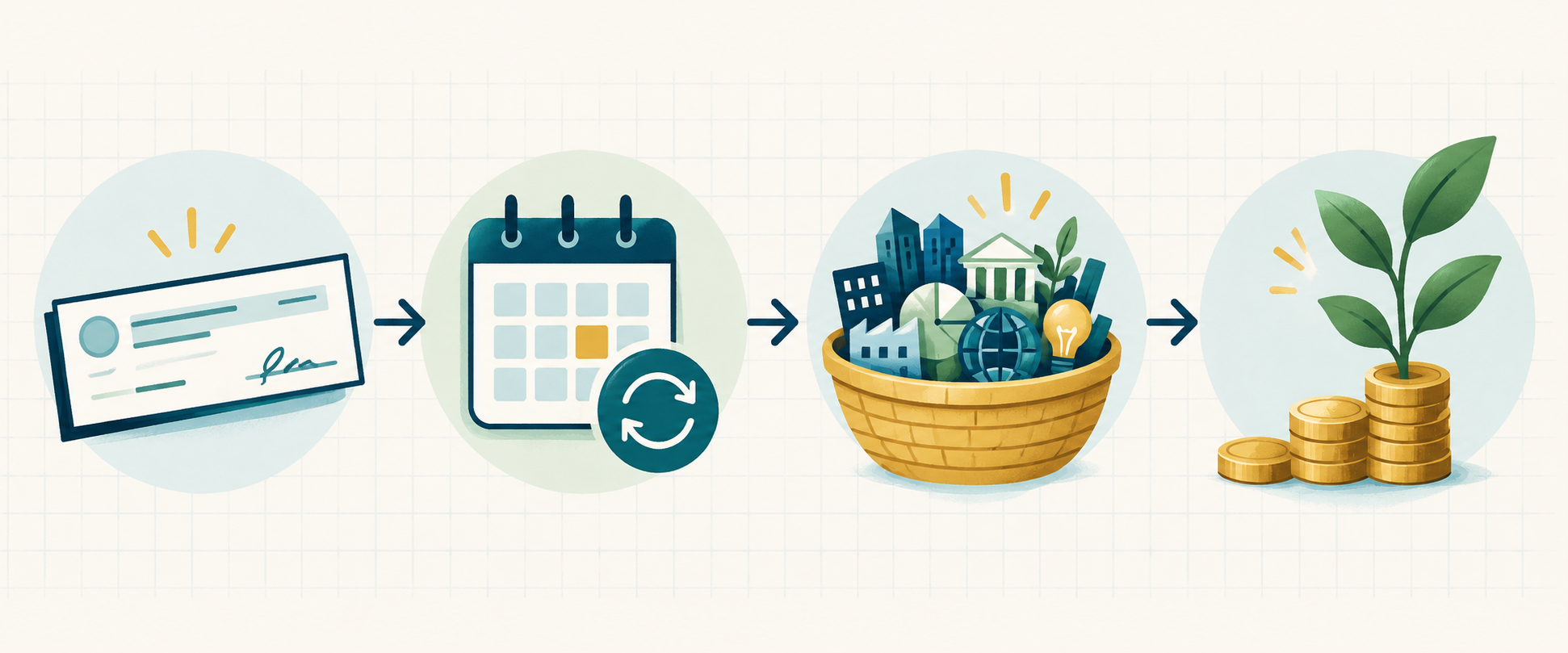
Dollar-cost averaging means investing equal amounts at regular intervals regardless of market ups and downs. Investor.gov notes that this pattern can lead you to buy more shares when prices are lower and fewer when prices are higher. It does not guarantee gains or protect against loss, but automation can reduce the pressure to make a fresh market-timing decision every payday.
Pick a frequency that follows your income: each paycheck, weekly, or monthly. Then choose an amount that leaves a margin. A plan that automatically pauses or needs a manual adjustment during an emergency is not a failure; it is a practical response to changing cash flow.
Consider an example. Maya has $50 available after every paycheck once bills, debt payments, and savings goals are funded. Rather than waiting for $1,000, she sets an automatic $50 contribution into her long-term account. Six months later, a car repair appears. Because she kept a separate cash buffer, she can handle the repair without selling the investments. She can also lower the next contribution temporarily if her budget needs room.
The important part of the example is not the dollar amount. It is the order: cash needs first, long-term contribution second, no pretending that emergencies will not happen.
Step 7: create a short review rule
Small accounts can invite too much checking because every movement looks dramatic in percentage terms. A better rule is to schedule a review—perhaps once or twice a year—and reserve unscheduled changes for genuine life events. Review contributions after a raise, job change, major debt payoff, new dependent, or a change in the goal’s deadline.
During a review, ask four questions:
- Is this money still for the same goal and time horizon?
- Has my ability to handle losses changed?
- Are contributions affordable, too low, or temporarily too high?
- Do my holdings, fees, and account choices still match the plan?
Rebalancing is different from chasing performance. Investor.gov explains that an allocation can drift as some holdings grow faster than others. A prewritten review rule helps you decide whether to rebalance based on your target allocation, not on fear or excitement. You can often direct new contributions toward an underweight area rather than making frequent trades, but tax and account consequences should be considered.

Common small-account mistakes to avoid
Waiting for perfect conditions. You cannot know the best short-term entry point in advance. A plan that depends on certainty may never start.
Investing emergency money. A market investment can be worth less when you need it. Keep a separate cash reserve for near-term shocks.
Buying something you cannot explain. Before investing, be able to say what it holds, how it makes or loses money, what it costs, and why it belongs in your plan.
Confusing many tickers with diversification. Several funds can still own the same companies or concentrate in the same sector. Examine underlying holdings and purpose.
Letting a small balance excuse high fees. Flat account fees and high expense ratios can matter disproportionately when you are starting out.
Making every headline an instruction. A diversified long-term plan should be designed with normal volatility in mind. If a modest drop makes the plan impossible to follow, the risk level or contribution size may need attention.
A one-page starter checklist
- I have named the goal and approximate time horizon.
- I have separated emergency cash from money meant to stay invested.
- I understand the account’s rules, fees, and tax treatment.
- I can describe the investment’s diversification and main risks.
- I chose a contribution I can make in an ordinary month.
- I set a review date instead of checking prices all day.
Starting small is not about finding a shortcut. It is about proving that your investing system works in real life. As income rises, debt falls, or other goals are funded, you can revisit the amount. The habit, account knowledge, and risk discipline you build with a small contribution are the parts that scale.
Frequently asked questions
Can I start investing with $10 or $25?
Possibly, if the account and investment choice allow it and your essentials are covered. The amount is less important than avoiding flat fees, using a diversified approach appropriate to your goal, and making contributions you can sustain.
Should I invest a lump sum or invest regularly?
That depends on your goal, cash flow, risk tolerance, and what the money is for. Regular investing can be practical for people investing from each paycheck. A large decision involving a lump sum may warrant personalized advice, especially when taxes or a near-term goal are involved.
What is the safest investment for a beginner?
There is no single answer without knowing the time horizon and purpose. Money needed soon generally needs more stability and access than money intended for a distant retirement goal. “Safe” also does not mean free from inflation risk or guaranteed return.
This article is for general education, not individualized investment, tax, or legal advice. Investing involves risk, including possible loss of principal. Consider a qualified professional for advice tailored to your situation.