
Most investing mistakes do not begin with a bad fund. They begin with a decision made at the wrong moment: chasing a hot market, selling after a frightening headline, or changing strategies because someone online sounds confident. A personal investment policy statement gives you something steadier to consult.
An investment policy statement, or IPS, is a short written agreement with yourself. It explains what your money is for, how you will invest it, when you will review the plan, and what you will do when markets become uncomfortable. Institutions have used formal investment policies for decades, but an individual investor can get much of the same benefit from one or two plain-language pages.
This guide shows you how to write an investment policy statement for your own accounts. It is educational, not personalized investment, legal, or tax advice. Your goals, tax situation, benefits, and ability to absorb losses are unique; consider consulting a qualified professional when the choices are complex.
What Is a Personal Investment Policy Statement?
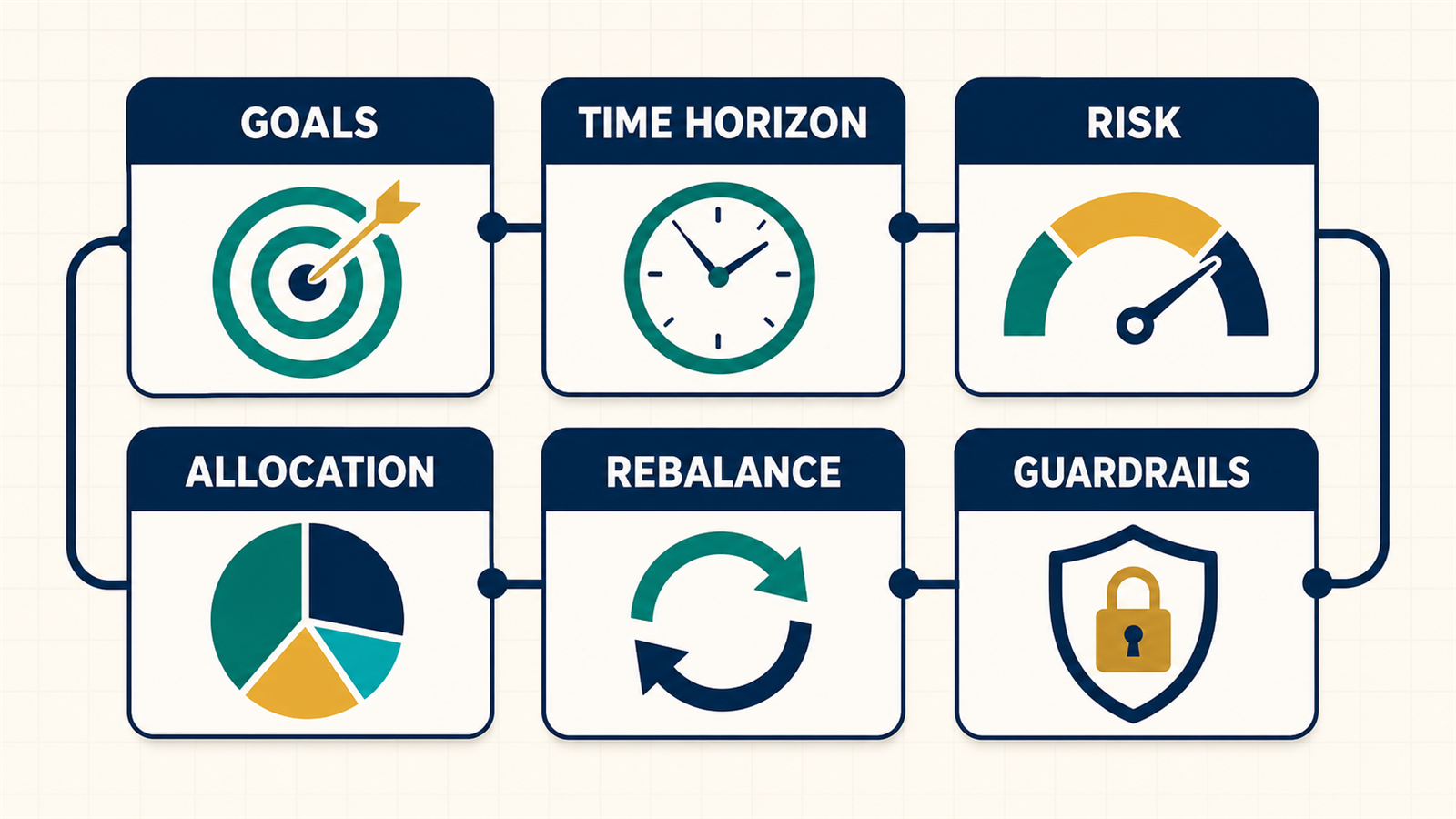
A personal IPS is a decision framework for your portfolio. It connects your financial goal to specific operating rules. Instead of merely saying, ?? want to invest for retirement,??it answers practical questions:
- What goal does this portfolio serve?
- When will the money be needed?
- How much will you contribute?
- How much loss and volatility can you realistically tolerate?
- What mix of investments will you maintain?
- When and how will you rebalance?
- Which investments or behaviors are off-limits?
The document is not a prediction, a list of winning stocks, or a promise of returns. It is also not permanent. You can update it when your life or goals change. What makes it valuable is that you decide the rules in a calm period, before market excitement or fear can dominate the choice. It can sit alongside the broader habits in our guide to smart money moves for financial success.
Why Write the Plan Down?
A mental plan is easy to revise without noticing. A written plan creates a reference point. When a speculative investment doubles, you can compare it with your concentration limit. When stocks fall, you can check your rebalancing rule instead of reacting to the day?? news. When a friend recommends a product, you can ask whether it fits your stated goal, time horizon, costs, and diversification standard.
Writing also exposes contradictions. You might discover that you describe yourself as conservative while holding a portfolio dominated by one volatile sector. Or you may expect to use the money in three years while investing it as though the goal were decades away. That discovery is useful: the SEC?? Investor.gov guidance on asset allocation emphasizes that time horizon and risk tolerance should influence the investment mix.
An IPS cannot prevent losses. Diversification and disciplined rebalancing do not guarantee a profit. The practical benefit is consistency: the document reduces the number of high-stakes choices you must improvise.
Before You Draft: Give Each Goal Its Own Job
Do not force all of your money into one strategy. A down payment in four years and retirement in thirty years have different time horizons and different consequences if the market falls just before the money is needed. They may deserve separate accounts, allocations, or policy sections.
Start by naming one goal for this IPS. Make it specific enough to guide decisions, but do not rely on a false sense of precision. For example:
??his portfolio is intended to help fund retirement beginning around age 67. I expect to contribute for at least 25 years and will not use it for routine expenses.??/p>
If your investing foundation is not ready, address that first. A cash reserve can reduce the chance that an unexpected bill forces you to sell long-term investments at a bad time. Our guide to building an emergency fund on a tight budget offers a practical starting point. High-interest debt, employer benefits, insurance needs, and near-term cash expenses also belong in the broader plan even if they are outside the IPS itself.
The 8 Parts of a Beginner Investment Policy Statement
1. Purpose and goal
Write one or two sentences describing what the portfolio should accomplish. Include a target date or approximate period and, if useful, a target amount. Treat the target as a planning input rather than a guaranteed outcome.
A good goal statement is measurable and connected to a real use. ??uild wealth??is vague. ??ccumulate funds for retirement beginning in about 25 years while making automatic monthly contributions??provides direction.
2. Contributions and withdrawals
State how money will enter and leave the account. You might set a dollar amount, a percentage of pay, or a rule such as increasing contributions after a raise. Note any expected employer match and whether dividends will be reinvested. If no withdrawals are planned before the goal date, say so.
Keep contribution rules realistic. A modest amount you can sustain is more useful than an aggressive promise you abandon after two months. If your income varies, use a base contribution plus a percentage of unusually strong months.
3. Time horizon and liquidity needs
Your time horizon is the period before you expect to use the money. Investor.gov notes that money for a short-term goal??oughly five years or less??enerally should not be exposed to the same risk as money for a distant goal. A market decline near the withdrawal date may leave too little time for recovery.
List any known withdrawals, such as tuition payments or the first years of retirement spending. If the goal date is flexible, record that too. Flexibility can influence how much short-term volatility you can endure, but it does not eliminate risk.
4. Risk capacity and risk tolerance
These are related but different. Risk capacity is your financial ability to absorb a loss without derailing the goal. Risk tolerance is your emotional willingness to live with uncertain returns and falling account values. The SEC defines risk tolerance in terms of both ability and willingness to accept possible loss for greater potential return.
Use a concrete stress test instead of an abstract label. Ask: ??f this portfolio fell 25% and headlines predicted worse, would I keep contributing, rebalance, freeze, or sell???Then compare the honest answer with the portfolio you are considering. A plan that looks optimal in a calculator but causes panic selling may be unsuitable in practice.
5. Target asset allocation
Asset allocation divides the portfolio among broad categories such as stocks, bonds, and cash. Your IPS should record the target percentages and, optionally, permitted ranges. It might also divide stocks into U.S. and international holdings or bonds by type. Keep the structure only as detailed as you can understand and maintain.
| Policy element | Illustrative entry | Why it matters |
|---|---|---|
| Target | 70% stocks, 25% bonds, 5% cash | Defines the intended risk mix |
| Range | Stocks may vary from 65% to 75% | Prevents constant trading |
| Diversification | Use broad, low-cost funds | Reduces dependence on one company or sector |
| Review | Check twice each year | Creates a calm review schedule |
The percentages above are only an illustration, not a recommendation. Your appropriate mix depends on your circumstances. If you want background on diversified funds, our beginner ETF investing guide explains how broad funds differ from narrow thematic exposure.
6. Investment selection rules
Describe the qualities an investment must have before it enters the portfolio. A simple policy could favor diversified, transparent funds with costs below a limit you choose and enough trading liquidity for the account. You can prohibit margin, options, leveraged products, individual stocks, cryptocurrency, or sector funds if they do not fit your goal or knowledge.
Costs deserve an explicit rule. The SEC?? bulletin on fees and expenses illustrates how recurring fees can materially reduce a portfolio over long periods. Your policy might require checking expense ratios, advisory fees, trading costs, account fees, and possible exit charges before investing.
If you want a small ??xplore??allocation for individual ideas, cap it in writing. For example, you might limit speculative holdings to a small percentage of the total portfolio and forbid adding money simply because a position has fallen. A boundary turns curiosity into a controlled choice instead of letting it quietly reshape the entire plan.
7. Rebalancing rule
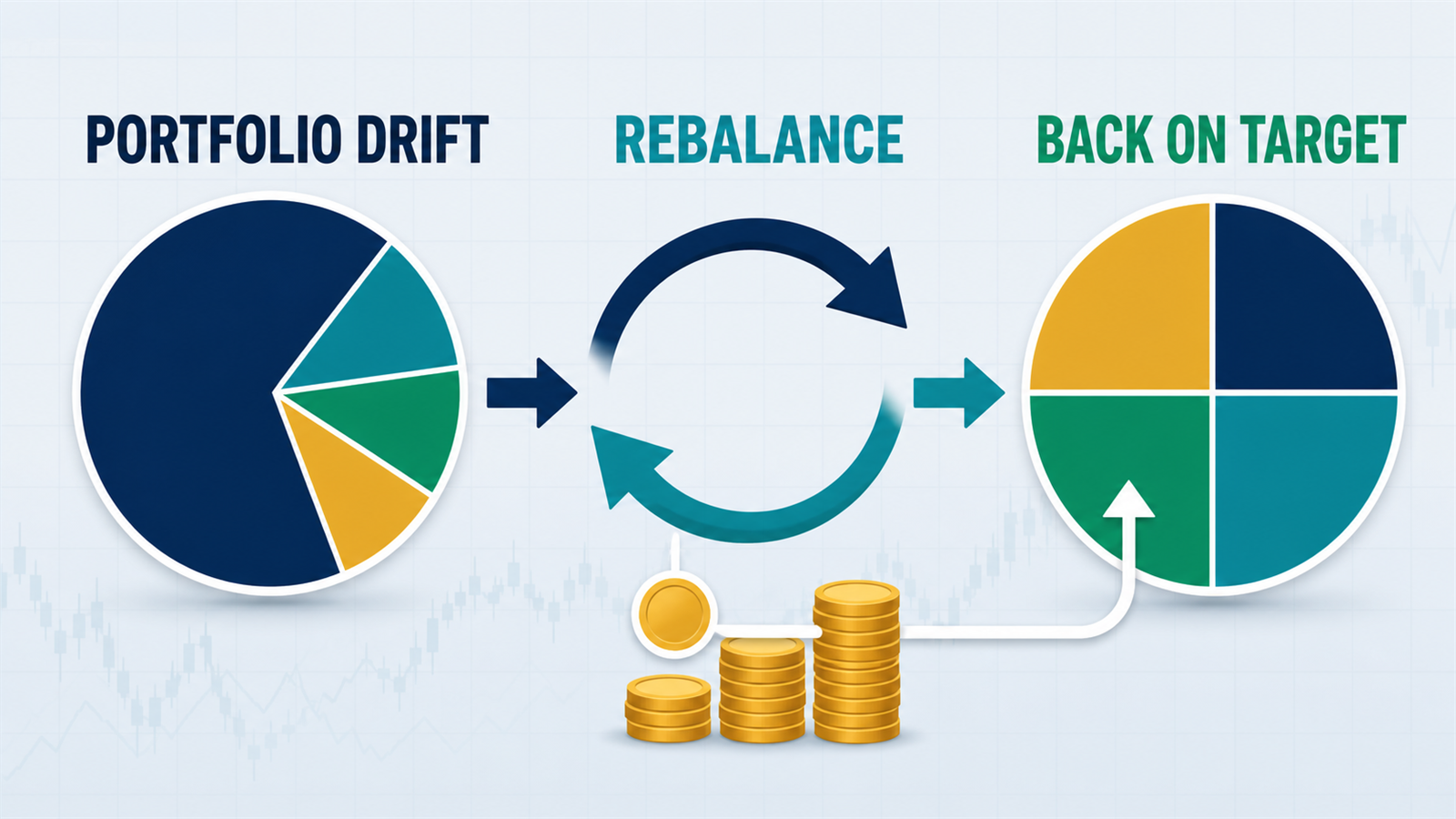
Market movements will pull your allocation away from its target. Rebalancing restores the intended mix. Your policy can use a calendar rule, a threshold rule, or both:
- Calendar: review every six or twelve months.
- Threshold: act when an asset class moves outside its permitted range.
- Combination: inspect on scheduled dates and trade only when a range is breached.
Investor.gov notes that rebalancing generally works best when done relatively infrequently. Before selling, consider whether new contributions or distributions can fill an underweight category. That approach may reduce trading, costs, and taxable gains. In a taxable account, evaluate the tax consequences before making changes; our tax withholding checkup is a useful reminder that investment income can affect the year?? overall tax picture.
8. Monitoring and change rules
Write down when the full IPS may change. Good reasons include a new goal, a shorter time horizon, a material change in income, a job loss, a disability, a major inheritance, or a shift from accumulation to withdrawals. A scary week in the market is not automatically a reason.
Separate three activities: monitoring, rebalancing, and redesigning. Monitoring checks whether the plan is being followed. Rebalancing returns the portfolio to its existing target. Redesigning changes the target itself. Mixing them together makes it easy to disguise market timing as ??aintenance.??/p>
A Simple Rebalancing Example
Suppose an investor starts with a target of 70% stocks and 30% bonds. After a strong stock market, the portfolio becomes 77% stocks and 23% bonds. If the IPS permits stocks only between 65% and 75%, the upper band has been crossed.
The investor reviews the entire portfolio, confirms that the goal and risk capacity have not changed, and redirects upcoming contributions toward bonds. If contributions are not enough, the investor may exchange part of the stock allocation for bonds while considering fees and taxes. The action follows a previously chosen rule; it is not a claim that stocks are about to fall.
This distinction matters. Rebalancing can mean trimming an asset that recently performed well and adding to one that lagged, which can feel uncomfortable. The written range makes that discomfort expected rather than surprising.
Add Behavioral Guardrails
The best IPS addresses the investor, not just the investments. Include rules designed for the moments when judgment is most vulnerable. Useful examples include:
- Wait 48 hours before buying an investment that is not already in the plan.
- Never trade solely because of a social-media post, price prediction, or breaking-news alert.
- Do not check a long-term portfolio more often than the chosen review schedule unless an account issue requires attention.
- Before selling during a decline, reread the goal, time horizon, and rebalancing section.
- Discuss any permanent allocation change with a spouse, accountability partner, or qualified adviser.

These rules are deliberately simple. Their purpose is to interrupt impulsive behavior long enough for the policy to re-enter the decision.
One-Page Investment Policy Statement Template
Copy the framework below into a document and complete it in your own words:
Purpose: This portfolio exists to ________ by approximately ________.
Contributions: I will contribute ________ each ________. Dividends will be ________.
Withdrawals: Planned withdrawals before the goal date are ________.
Time horizon: I expect to invest for ________. My flexibility is ________.
Risk statement: I understand the portfolio can lose value. If it falls substantially, I will ________.
Target allocation: Stocks ___%; bonds ___%; cash ___%; other ___%.
Permitted ranges: ________.
Selection rules: Investments must meet these cost, diversification, and simplicity standards: ________.
Prohibited investments or behaviors: ________.
Rebalancing: I will review ________ and rebalance when ________.
Review: I will review this IPS on ________ or after these life changes: ________.
Date and sign the document. Store it somewhere easy to retrieve but separate from market alerts. If you manage retirement savings across several accounts, decide whether the allocation applies to every account independently or to the combined household portfolio. Our retirement readiness checklist can help identify planning gaps that the policy should acknowledge.
Common Investment Policy Statement Mistakes
Making the plan too complicated
A ten-page policy filled with jargon is not automatically better. If you cannot explain a rule or calculate whether you are following it, simplify it. The document should help you act.
Using expected returns as promises
Planning assumptions can help estimate contributions, but markets do not owe you a particular return. Build flexibility into the goal and periodically update the savings requirement instead of reaching for more risk to repair a shortfall.
Confusing more funds with more diversification
Several funds may own many of the same securities. Investor.gov recommends checking the holdings of narrowly focused funds because multiple fund names do not guarantee meaningful diversification.
Changing the policy after every market move
A policy that changes whenever prices change is not functioning as a policy. Revisit it because your circumstances changed or because the original assumptions were unsuitable??ot because recent returns created excitement or fear.
Ignoring taxes and account rules
Selling in a taxable account may generate gains or losses, while retirement accounts have their own contribution and withdrawal rules. Confirm the consequences before acting. A portfolio rule should never require you to ignore the law, plan terms, or a material tax cost.
Frequently Asked Questions
Do beginners really need an investment policy statement?
Beginners may benefit most because the document turns unfamiliar decisions into a small set of repeatable rules. It can be one page and evolve as your knowledge and circumstances change.
How long should a personal IPS be?
One to three pages is enough for many individual investors. It should be detailed enough to guide contributions, investment selection, rebalancing, and reviews without becoming difficult to use.
How often should I update it?
Review it on a regular schedule, such as annually, and after meaningful life changes. Reviewing does not mean changing it. If the goal, time horizon, financial capacity, and risk tolerance remain appropriate, the best update may be no update.
Is an IPS the same as a financial plan?
No. A financial plan can cover cash flow, debt, insurance, taxes, estate planning, and multiple goals. An IPS is the operating policy for investing a specific portfolio or group of accounts within that larger plan.
Can I use an IPS with a target-date fund or robo-adviser?
Yes. The policy can document why you chose the solution, what it costs, how it fits the goal, and when you will review it. The product may automate allocation and rebalancing, but you still decide the goal, contributions, withdrawals, and behavioral rules.
Your Next Step
Set aside 30 quiet minutes and draft the one-page template. Do not begin by searching for the perfect fund. Begin with the goal, the time horizon, and an honest description of risk. Then choose a simple allocation and maintenance rule you understand.
A useful investment policy statement will not tell you what the market will do next. It will remind you what you decided to do??nd why??hen the next surprise arrives.
Disclosure: This article is for general education only and is not individualized investment, tax, or legal advice. Investing involves risk, including possible loss of principal. Consider your circumstances and seek qualified professional guidance when appropriate.