Tax Withholding Checkup: How to Avoid a Surprise Tax Bill
A tax refund can feel like a bonus, while a balance due can feel like an ambush. Neither result is random. In most cases, it reflects how closely the tax paid during the year matched the tax ultimately calculated on the return.
That is why a tax withholding checkup matters. It helps you compare what is coming out of your paychecks with the income, deductions, and credits you expect for the year. If the numbers no longer line up, you can adjust before filing season rather than discovering the problem months later.
This guide explains how federal withholding works, when to review it, how to use the IRS estimator, and when estimated tax payments may be useful. It is general educational information, not individualized tax, legal, or financial advice. State and local tax rules may require a separate review.
What Is Tax Withholding?
Federal income tax withholding is money an employer takes from an employee’s pay and sends to the IRS on the employee’s behalf. The amount is generally based on wages, pay frequency, and the information supplied on Form W-4.
The federal income tax system is pay-as-you-go. Instead of waiting until you file a return, you generally pay throughout the year through paycheck withholding, estimated tax payments, or a combination of both. When you file, the return compares your total tax with the payments already credited to you.
- If payments were greater than the tax owed, you may receive a refund.
- If payments were smaller than the tax owed, you may have a balance due.
- If too little was paid during the year, an underpayment penalty may also apply in some situations.
The objective is not necessarily to produce a zero-dollar result. Tax calculations involve estimates and changing circumstances. A practical goal is to avoid a large, preventable mismatch while keeping enough cash in each paycheck to run your household.
Why Your Current W-4 Can Become Outdated
A W-4 is a snapshot of the assumptions you made when you completed it. Your tax situation can change even when the form stays the same. A raise, second job, marriage, investment gain, new child, or side business can make an older withholding election less accurate.
The IRS recommends checking withholding every January and after major life changes. A checkup is especially useful after:
- Starting a new job or adding a second job
- A major increase or decrease in household income
- Marriage, divorce, or separation
- The birth or adoption of a child
- Buying a home
- Starting retirement or receiving pension income
- Beginning freelance, gig, rental, or business activity
- Receiving substantial interest, dividends, capital gains, or IRA distributions
- Becoming eligible or ineligible for a meaningful deduction or credit

Some changes pull withholding in opposite directions. A higher salary may raise expected tax, while a new dependent may create eligibility for a credit. That is why broad rules of thumb can be unreliable. A checkup should consider the combined household picture.
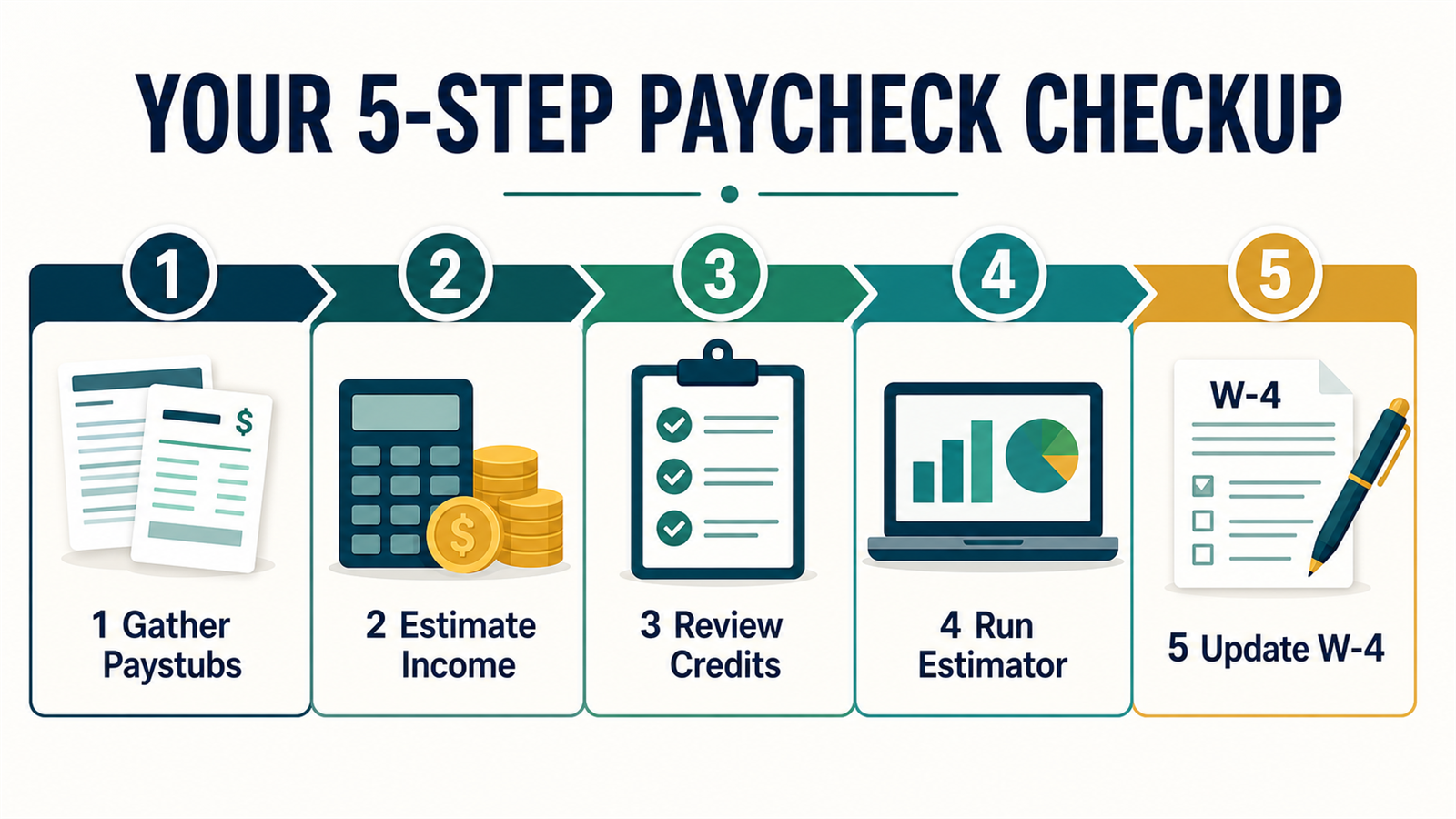
The Five-Step Tax Withholding Checkup
You do not need to estimate your tax from memory. The IRS provides a Tax Withholding Estimator for people with W-2 employment or pension and annuity income subject to federal withholding. The IRS says the tool can generate a pre-filled Form W-4 or W-4P based on the information entered.
Step 1: Gather Current Pay Information
Collect the most recent paystub for every job in the household. If you expect to file jointly, include your spouse’s pay information. The paystub should show year-to-date wages and federal income tax withheld, not merely the latest paycheck amount.
Also gather pension or annuity statements if applicable. The estimator works best when the year-to-date information is current because it needs to account for both payments already made and pay periods remaining.
Step 2: Estimate Income Outside Your Paycheck
List taxable income that may not have automatic withholding. Common examples include freelance profit, gig income, bank interest, dividends, capital gains, rental income, prizes, and certain retirement distributions.
Use realistic estimates rather than the largest number that passed through an account. For a small business or side hustle, taxable profit is generally different from gross customer payments because ordinary and necessary business expenses may affect the calculation. Good records matter. Keep business income and spending organized instead of reconstructing the year from bank statements during filing season.
If side income is part of your broader financial plan, connect the tax reserve to your cash-flow system. Our guide to building an emergency fund on a tight budget can help you keep emergency savings separate from money set aside for taxes.
Step 3: Review Expected Deductions and Credits
Have your most recent federal return available. It provides a useful starting point for filing status, dependents, deductions, credits, and income sources. Then identify what will be different this year.
A deduction generally reduces income subject to tax, while a credit generally reduces tax itself. They are not interchangeable. The value also depends on eligibility rules and your overall return. Review our tax deductions guide for a broader explanation, but verify current requirements with official IRS instructions or a qualified tax professional.
Avoid entering a deduction or credit merely because you claimed it last year. Changes in income, household status, education expenses, childcare, home ownership, or tax law may change the result.
Step 4: Run the IRS Estimator
Enter the information from your paystubs, return, and other records into the estimator. According to the IRS, the tool does not ask for your name, Social Security number, address, or bank account number, and entries are cleared when the browser window closes.
The result estimates whether current withholding is on pace and allows you to test adjustments. Run more than one scenario if income is uncertain. For example, a freelancer with a seasonal business could compare a conservative profit estimate with a stronger year. Scenario planning is more useful than pretending an uncertain number is exact.
Step 5: Update Form W-4 and Verify the Change
If the estimator indicates a change is appropriate, use its output to prepare a new Form W-4 and submit it to your employer through the process your workplace requires. Pension or annuity recipients may use Form W-4P with the payer.
Then verify the change on a later paystub. Do not assume a submitted form was processed immediately or exactly as expected. Payroll timing varies, and a midyear change may need another review near the end of December so the next calendar year starts with an appropriate election.
How to Read Form W-4 Without Guessing
Form W-4 does not work like the old allowance system many employees remember. The current form asks for filing status and provides sections for multiple jobs, dependents, other income, deductions, and additional withholding.
The main sections are:
- Step 1: Personal information and anticipated filing status
- Step 2: Multiple jobs or a spouse who also works
- Step 3: Qualifying children, other dependents, and certain credits
- Step 4: Other income, deductions beyond the standard deduction, and additional tax withheld each pay period
- Step 5: Signature
Do not copy a friend’s form or choose entries based only on whether you want a refund. A married couple with two jobs can have a different result from a one-income married household earning the same total amount. Multiple jobs are a common source of underwithholding because each payroll system may calculate as though that job were the household’s only income.
The estimator is often the clearest way to translate a household situation into form entries. Keep a copy of what you submit and note the date, especially if you make more than one adjustment during the year.
Withholding Versus Estimated Tax Payments
Withholding is not the only way to pay tax during the year. People with income that has little or no withholding may need estimated tax payments. The IRS lists self-employment income, interest, dividends, capital gains, prizes, and certain other income as common reasons estimated payments may be necessary.
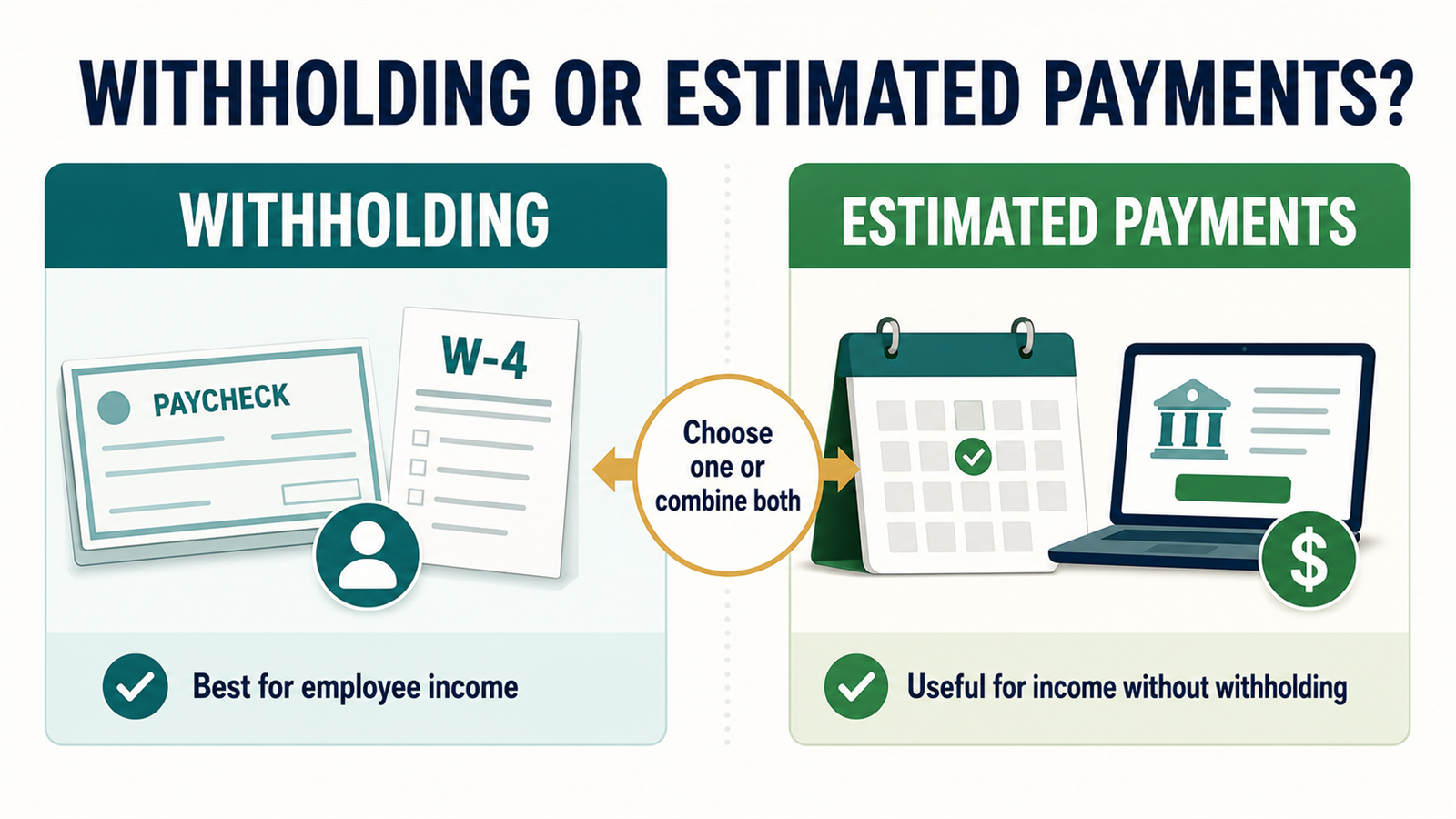
If you have a W-2 job plus side income, increasing paycheck withholding may be simpler than managing separate payments. Another person may prefer quarterly payments because business cash flow is variable and they want a clear separation between payroll and business taxes. The right method depends on timing, predictability, and administrative preference.
Estimated tax periods are not four equal calendar quarters, and exact due dates can shift when a date falls on a weekend or legal holiday. Use the current IRS estimated tax guidance and Form 1040-ES rather than relying on a remembered schedule.
A Practical Example: Two Jobs and Freelance Income
Suppose Maya works full time, takes a weekend job in March, and begins freelance design work in May. Her original W-4 was completed when the full-time job was her only income. Both employers withhold tax, but neither payroll system automatically knows the household’s combined income. Her freelance clients do not withhold federal income tax.
Maya’s checkup would include year-to-date pay and withholding from both jobs, expected wages for the remaining pay periods, estimated freelance profit, and any expected credits or deductions. After running the estimator, she might choose additional withholding at her main job, estimated payments, or a combination.
The important move is not a particular dollar amount. It is recognizing that the original form no longer represents the facts. Waiting until filing season would turn a manageable midyear adjustment into a potentially larger balance due.
Common Withholding Mistakes to Avoid
Treating a Large Refund as Free Money
A refund can be useful forced savings, but it generally represents your own money returning after more was paid during the year than the final tax required. Consider whether a deliberately large refund is worth the smaller paychecks. If you change withholding to increase take-home pay, give that money a job such as debt reduction, savings, or investing rather than letting it disappear into routine spending.
Our smart money moves guide offers a framework for directing extra cash toward priorities instead of absorbing it into lifestyle creep.
Ignoring the Second Job
A second job can create a mismatch even when both employers withhold something. Review the multiple-jobs section of Form W-4 or use the estimator with all paystubs together.
Using Gross Side-Hustle Revenue as Profit
Gross receipts and net profit are different. Track legitimate business expenses, but do not invent deductions or mix personal costs into the business. Reliable bookkeeping makes both estimated payments and the eventual return easier.
Adjusting Once and Never Checking the Paystub
After submitting a W-4, inspect a later check. Confirm that federal income tax withholding changed and that the new net pay still works with your budget. A tax adjustment should not cause missed bills or force you to raid savings.
Forgetting That Federal and State Withholding Are Separate
The federal W-4 addresses federal income tax. A state may have its own withholding form, estimator, rules, and payment schedule. Review both systems when your state imposes an income tax.
Relying on Last Year’s Rules Without Verification
Tax brackets, deductions, credits, and income thresholds can change. Our overview of tax law changes can help you identify questions, but official forms, instructions, and professional advice should control your filing decisions.
How Often Should You Check Withholding?
A simple schedule is:
- January: Check the new year’s pay rate, benefits, filing assumptions, and tax-law changes.
- After a major life or income event: Review as soon as you have reliable new information.
- Midyear: Compare year-to-date withholding with updated income estimates.
- Early fall: Make a final meaningful check while several pay periods remain.
- After any adjustment: Confirm the result on a later paystub.
Retirees should include pension withholding and retirement-account distributions in the review. If retirement planning is becoming a priority, use our retirement readiness checklist to connect tax payments with income planning, healthcare, debt, and cash reserves.
Tax Withholding Checkup Checklist
- Most recent paystub from every job
- Spouse’s paystubs if filing jointly
- Pension or annuity payment statements
- Most recent federal tax return
- Expected wages for the full year
- Estimated freelance, gig, rental, or business profit
- Expected interest, dividends, gains, and retirement distributions
- Likely deductions and credits
- IRS estimator results and a copy of any updated W-4
- A follow-up paystub confirming the adjustment
Frequently Asked Questions
How do I know if enough federal tax is being withheld?
Use current paystubs and realistic full-year income estimates in the IRS Tax Withholding Estimator. The amount on one paycheck alone does not show whether the full-year result is on track.
Can I ask my employer to withhold an extra amount?
Form W-4 includes a line for additional tax to be withheld each pay period. Use the IRS estimator or professional guidance to choose an amount instead of guessing.
Should I change my W-4 to get a bigger refund?
You can choose more withholding, but a bigger refund usually means smaller paychecks during the year. Decide whether that tradeoff supports your cash-flow and savings habits.
Do I need estimated payments if I have a side hustle?
Possibly. It depends on total expected tax, withholding, credits, and other facts. Some employees cover side-income tax by increasing paycheck withholding; others make estimated payments. Review IRS estimated-tax guidance or consult a qualified tax professional.
Does changing my W-4 affect Social Security or Medicare tax?
Form W-4 primarily changes federal income tax withholding. Payroll taxes such as Social Security and Medicare follow separate rules.
What if my income changes again after I update my W-4?
Run another checkup. There is no rule that a W-4 must remain unchanged for the entire year. Use current information and verify each adjustment on a later paystub.
Final Takeaway
A surprise tax bill often starts with an old assumption: one job became two, income rose, a side business started, a household changed, or an expected credit disappeared. A withholding checkup catches that mismatch while there is still time to respond.
Gather current records, estimate the full household picture, use the IRS estimator, submit an updated form if needed, and verify the result. Twenty-five focused minutes now can make filing season far more predictable.