Tax Document Checklist: What to Keep and For How Long
Tax paperwork is easy to ignore until a lender asks for it, a return needs amending, or a sale forces you to reconstruct a number from years ago. A simple tax document checklist prevents that scramble. It also keeps you from holding every receipt forever simply because you are afraid to throw anything away.
The useful question is not “How many years do I keep every tax paper?” It is: what does this document prove, and how long could that proof matter? The answer depends on the record, the return it supports, and whether it affects a future sale or deduction. This guide gives you a practical household system, not individualized tax or legal advice. State rules and unusual circumstances can differ, so use a qualified professional for your situation.
Start With the IRS Principle, Not a Random Number
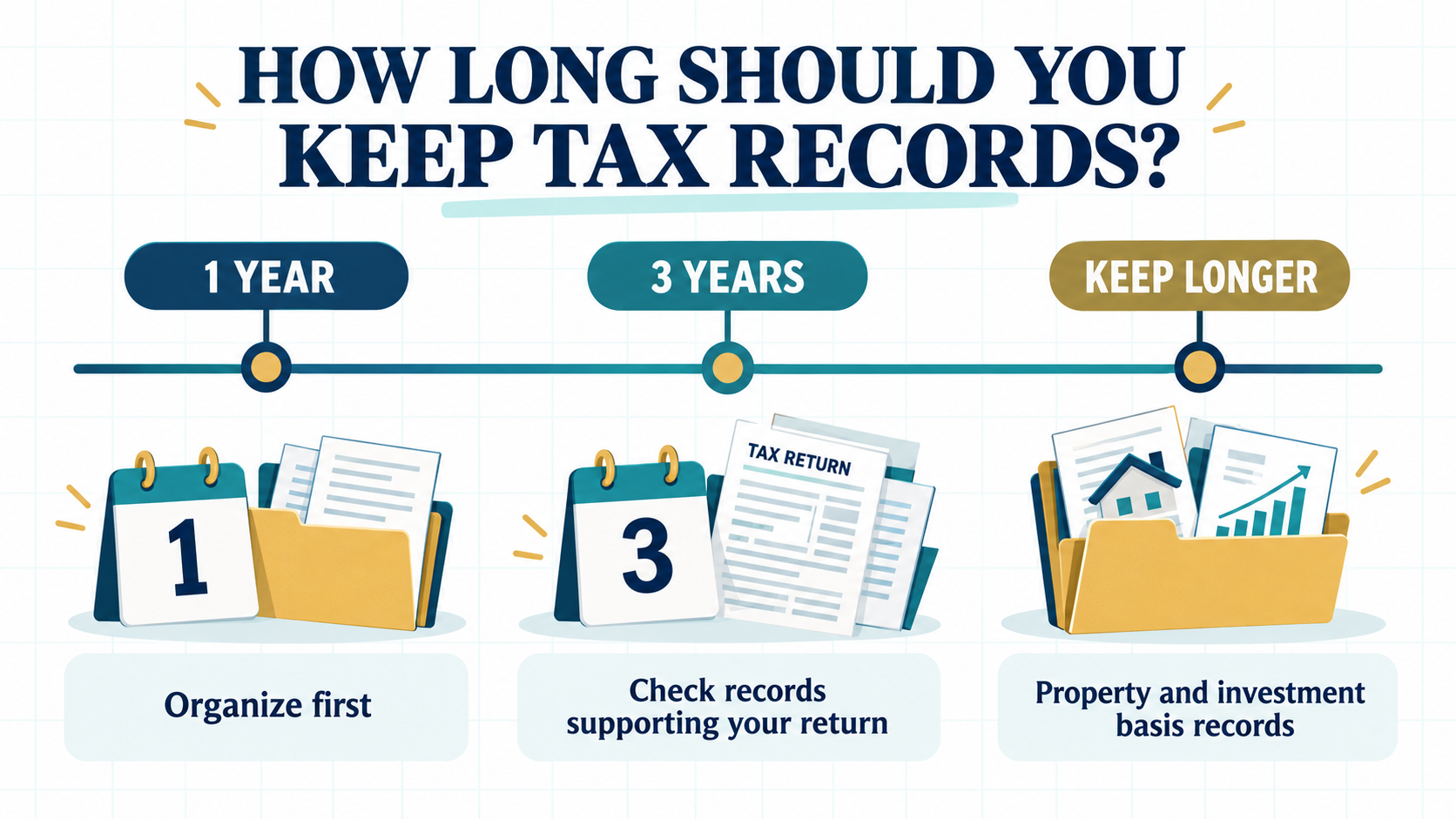
The IRS says to keep records supporting income, deductions, and credits for as long as they may be material to administering the tax law. For many ordinary federal returns, the assessment period is generally three years after filing. That does not make “three years” a universal shredding rule. A longer period can apply to particular situations, and records that establish the basis of property may matter long after the original purchase.
Build your files around two groups. First are annual-return records: the forms and receipts that explain the income, deductions, and credits on a particular return. Second are long-life basis records: the papers that explain what you paid for an asset and what changed its cost over time. Keeping those groups separate makes the system much easier to maintain.
Your Annual Tax Return File
Create one folder—digital, paper, or both—for each tax year. Put the final signed return, confirmation of electronic filing, proof of payment or refund, and the documents used to prepare it in that folder. Label it with the tax year rather than the filing date. A return filed in April 2027 normally belongs in the 2026 folder.
For each annual file, keep copies of income forms such as W-2s, 1099s, K-1s, Social Security statements, brokerage tax forms, retirement-distribution forms, and records of estimated tax payments. Keep the statements or receipts that support deductions and credits you actually claimed. If your return reports self-employment income, preserve the records that show both revenue and ordinary business expenses.
A final return is a useful summary, but it is not a substitute for support. If a figure came from a form, invoice, mileage log, charitable acknowledgment, closing statement, or worksheet, that underlying record belongs with the return. Make a brief note for unusual items so that a future you—or a preparer—can understand the story without guessing.
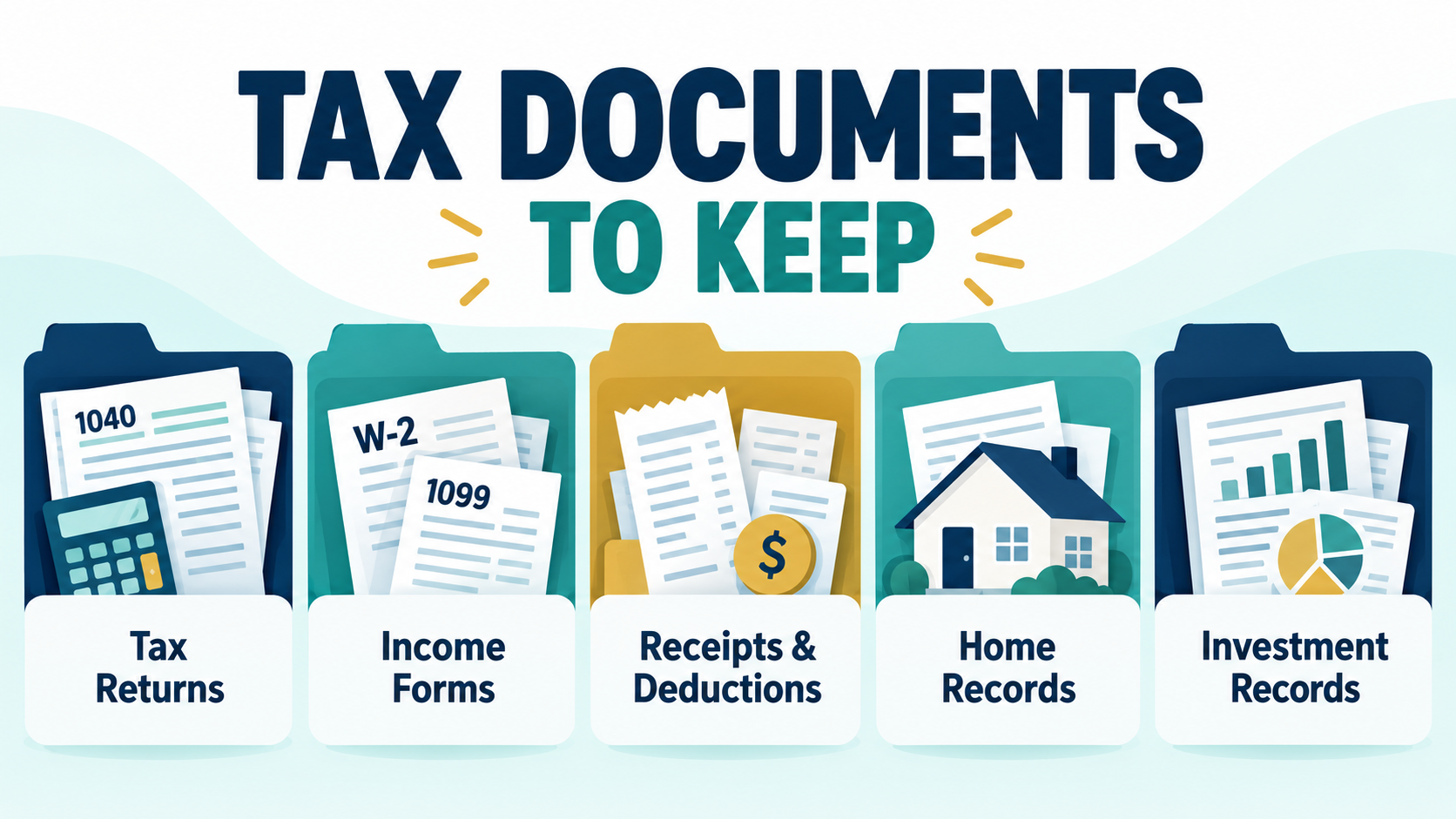
Documents Most Households Should Sort Each Year
Use this checklist as an inbox during the year. It is far less stressful to drop a record into the correct folder when it arrives than to search email, drawers, and portals next spring.
- Income: W-2s, 1099-NEC and 1099-MISC forms, 1099-INT and 1099-DIV forms, 1099-Rs, unemployment statements, K-1s, gig-platform summaries, and records of cash or freelance income.
- Payments: federal and state estimated-tax confirmations, extension-payment confirmations, and notices showing a balance paid.
- Health coverage: Forms 1095-A, 1095-B, or 1095-C when applicable, plus marketplace information needed for a premium tax credit.
- Deductions and credits: charitable acknowledgments, education forms, dependent-care records, qualifying energy or vehicle paperwork, and documents for deductions you claim.
- Business support: invoices, expense receipts, mileage logs, payment-processor reports, and bookkeeping reports.
Do not confuse a bank or credit-card statement with a complete receipt. A statement may show that money left your account, but the receipt, invoice, or acknowledgment can be the document that explains what the payment was for. Save both when an expense needs specific support.
How Long Should You Keep Regular Tax Records?
For a normal filed federal income-tax return, the IRS generally describes a three-year period. It also lists situations with different periods: a claim involving bad debt or worthless securities can have a seven-year period; substantial omissions of income can lead to a six-year period; and fraud or failure to file can have no assessment limit. That is why a blanket “delete everything after three years” policy is too blunt.
A practical starting point is to retain the filed return and its ordinary supporting documents for at least the applicable federal period, then check whether a longer rule applies before disposing of anything. If you amended a return, received a notice, made a claim for refund, have a business, or have state obligations, slow down and verify the relevant rule. Your tax professional can help turn that general rule into a schedule for your file cabinet.
Keep a permanent digital copy of each filed return even after routine support ages out. Old returns can help with future returns, loan applications, financial-aid questions, retirement planning, and a missed cost-basis puzzle. They are compact, valuable reference documents.
Property Records Need Their Own Folder
Property files deserve special treatment because they help establish basis—the starting amount used to calculate gain or loss when you sell or otherwise dispose of an asset. The IRS says to keep property records until the limitation period expires for the year of the taxable disposition. In plain language: do not throw away home, investment, or business-property records merely because the purchase happened years ago.
For a home, retain the purchase closing disclosure or settlement statement, records of capital improvements, insurance reimbursement details after a casualty, and documents from a later sale. A repair that merely maintains the home is different from an improvement that adds value, adapts it to a new use, or restores it; keep the paperwork and notes so you can explain the classification later. Our guide to hidden costs of buying a house is a useful companion when organizing the full cost of ownership.
For investments, retain trade confirmations and records of reinvested distributions, mergers, spinoffs, inherited assets, and other events that can change basis. A brokerage may report basis, but your own archive is prudent—especially when assets moved between firms or have a long history. Keep records for collectibles, rental property, and business equipment with the same care.
What About Retirement and Health Records?
Retirement account forms can affect taxes in several years. Keep contribution records, 1099-Rs, rollover documentation, and evidence of after-tax contributions when applicable. A Roth IRA conversion, a nondeductible IRA contribution, or a rollover creates a paper trail that can matter later. Keep it with your retirement account file as well as the annual tax folder. For more on the bigger planning picture, see our retirement readiness checklist.
Likewise, save records connected to a health savings account, marketplace coverage, or major medical deductions that appear on a return. Tax rules, employer reporting, and future reimbursement questions can overlap. The goal is not to preserve every explanation-of-benefits indefinitely; it is to keep the records that substantiate the tax position you took.
Receipts, Digital Copies, and Common Recordkeeping Mistakes
Paperless does not automatically mean organized. Download the actual annual statement, confirmation, or PDF when it becomes available instead of relying on the assumption that a portal will preserve it forever. Employers change payroll providers, banks close old online access, and merchants do not always retain a receipt for as long as you do. A download stored in your own labeled folder gives you control of the record.
For receipts that fade, scan them promptly. Include the date, merchant, amount, business purpose or category, and the tax year in the filename or nearby note. For a charitable gift, retain the acknowledgment with the organization name, gift date, amount, and any goods or services received in return. For a business purchase, make the link between the receipt and the business purpose easy to see. A year later, a stack of images named “IMG_4872” is almost as unhelpful as a shoebox.
Avoid mixing personal and business transactions whenever possible. Use a dedicated card or account for a small business, then reconcile it regularly. That does not turn an expense into a deduction by itself, but it makes the supporting records clearer and reduces the risk of omitting income or claiming the same cost twice. If a household account must be used, add a short written note while the purpose is fresh.
Another common mistake is saving only documents that seem favorable. Income forms are records too. A complete folder lets you reconcile the return with the forms you received and makes it easier to notice a duplicate, correction, or missing 1099. Aim for an accurate file, not a persuasive one.
Finally, do not treat tax records as the only part of your financial archive. Important estate documents, insurance policies, loan agreements, beneficiary designations, and account inventories have their own retention needs. Keep a simple index that tells a trusted person where the critical records are stored, without putting passwords or account numbers in that index.
Consider a one-page cover sheet in every annual folder. List the filing status, preparer or software used, any extension, estimated payments, amended-return activity, and a sentence explaining unusual events such as a move, stock sale, inheritance, rental start, or new business. The cover sheet is not tax support; it is a map to the support. That map saves time when you need to compare years, answer a letter, or bring a new professional up to speed.
Make the review date visible on the folder. A recordkeeping system only works when it is revisited, and a dated label turns a vague intention into a clear next action for the household, year after year, without relying on memory or last-minute panic.
Build a System You Will Actually Use
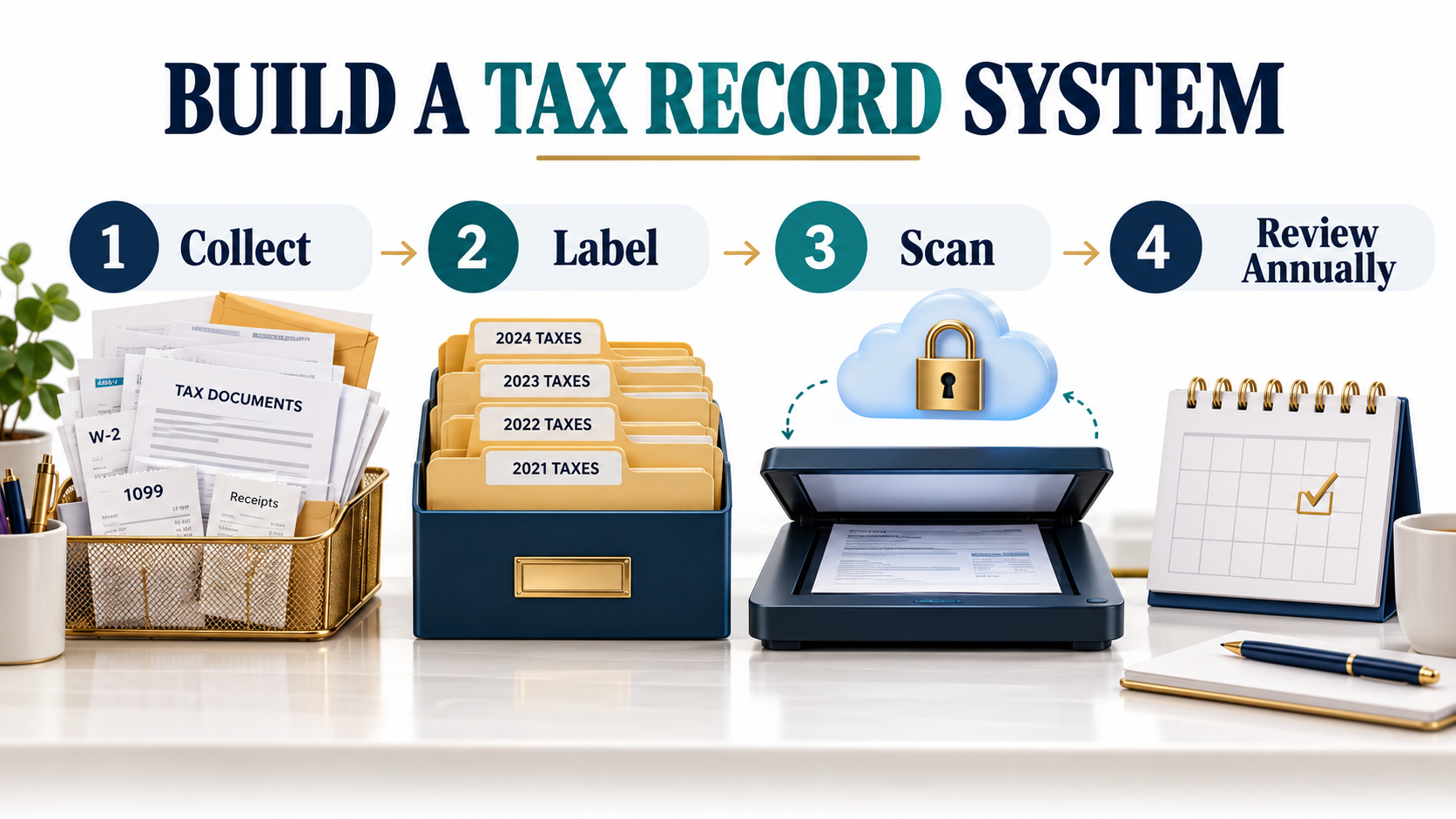
Choose a simple naming pattern: 2026 / Income / W-2 Employer Name, 2026 / Deductions / Charity Name, and Property / Home Address / 2026 Kitchen Remodel. Consistent names make files searchable and make handoffs easier for a spouse, executor, or preparer.
Use two storage locations for documents that contain sensitive information. For example, keep paper originals in a locked, dry place and encrypted scans in a reputable cloud-storage account protected by a unique password and multi-factor authentication. Do not email unencrypted Social Security numbers or leave tax folders in a shared downloads directory. If you scan documents, review the image for legibility before shredding a nonessential original.
A 30-Minute Annual Recordkeeping Routine
Set a calendar reminder after you file. First, save the filed return, e-file confirmation, and payment or refund record in that year’s folder. Second, move all supporting forms and receipts used by the return out of your inbox and into labeled subfolders. Third, update your property and investment-basis folders with any purchases, improvements, sales, or corporate actions from the year. Finally, make a short list of documents you are still waiting to receive.
Then set a second reminder before the next filing season. Review the previous year’s folder, confirm that digital backups open, and identify which records should be retained longer. This small ritual creates a clean runway for filing. It also helps you catch tax documents that arrived in a portal but never made it to your tax-prep folder.
When You Need an Old Record You Cannot Find
Start with the source that created it: your employer, bank, broker, school, mortgage servicer, payroll platform, or tax preparer. The IRS also provides tax-account and transcript options through an Individual Online Account. A transcript can be helpful, but it may not replace the original documentation needed for every purpose. If you need a photocopy of a filed return, the IRS describes a separate request process.
Missing records are a reason to improve your system, not to invent numbers. Reconstruct only from credible documents, and ask a tax professional before filing an amended return or responding to a notice. Keep the reconstruction notes in the same folder so the decision can be understood later.
Before You Shred: A Final Checklist
- Is the document part of a return still inside the relevant limitation period?
- Could it prove the basis of a home, investment, rental property, or business asset?
- Does it support a carryforward, retirement contribution, health account, or tax credit?
- Does your state, insurer, lender, or another institution require a longer retention period?
- Do you have a readable, secure backup if you are discarding paper?
If the answer to any question is yes or uncertain, keep it and revisit later. When it is time to dispose of documents containing personal information, use a cross-cut shredder or a secure shredding service. Good records are not about keeping paper forever; they are about being able to prove the right thing at the right time.
A clean tax document checklist supports more than filing season. It reduces decision fatigue, protects sensitive information, and gives your financial plan a reliable paper trail. Pair it with a cash reserve for unexpected costs—our emergency fund guide can help—and make the annual review part of your broader money routine.